Yes, this is copied from Substack, which allows LaTeX. Read it there is you want to be able to see the remarkably simple equations.
Yes, I’m still going on about the fundamental physics of gravity. It’s a hobby. I keep making progress. Remember, I’m writing this as I figure it out. You get to watch me make mistakes in real time.
Now that I’ve made a complicated, hard to read graphic (with an error baked in), I’ve made better graphics (minus the stupid error about acceleration being halved). Here it is. It’s so much simpler and easier to understand.
The basic premise is that gravity is derived from the field of potential energy, from which all other energies withdraw. The field has a top, herein at one. It has a bottom at zero. You can’t take more than there is, and you can’t take less than nothing. The field deforms as the inverse of the distance from the center, starting at 1 unit from the center. Why there? Anything closer is inside. Changes to the field propagate at a fixed rate: the speed of light. Acceleration is negative to show attraction towards. The speed of light = 1.
This is a black hole. Is it at a cosmic scale using r=1 as the Schwarzschild radius, or the Planck scale using r=1 as the Planck length? You decide. The math is the same.
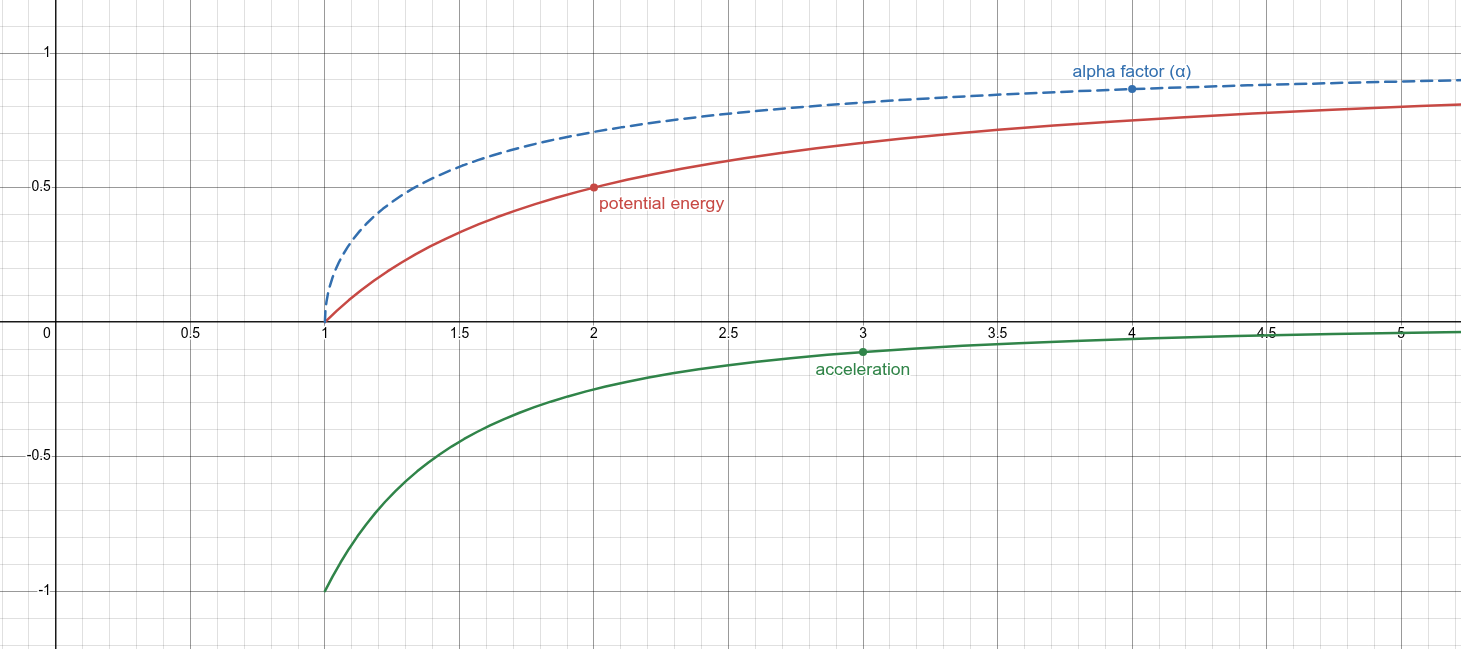
Where do these curves come from?
Those are the basics. Simple, clean, elegant. The acceleration is the slope of the 1/r curve. Amazingly enough, alpha corresponds to the cosine of the angle Theta to which the acceleration is the tangent. This is the slope of the 1/r curve.
Here is the more complete, more complex version.
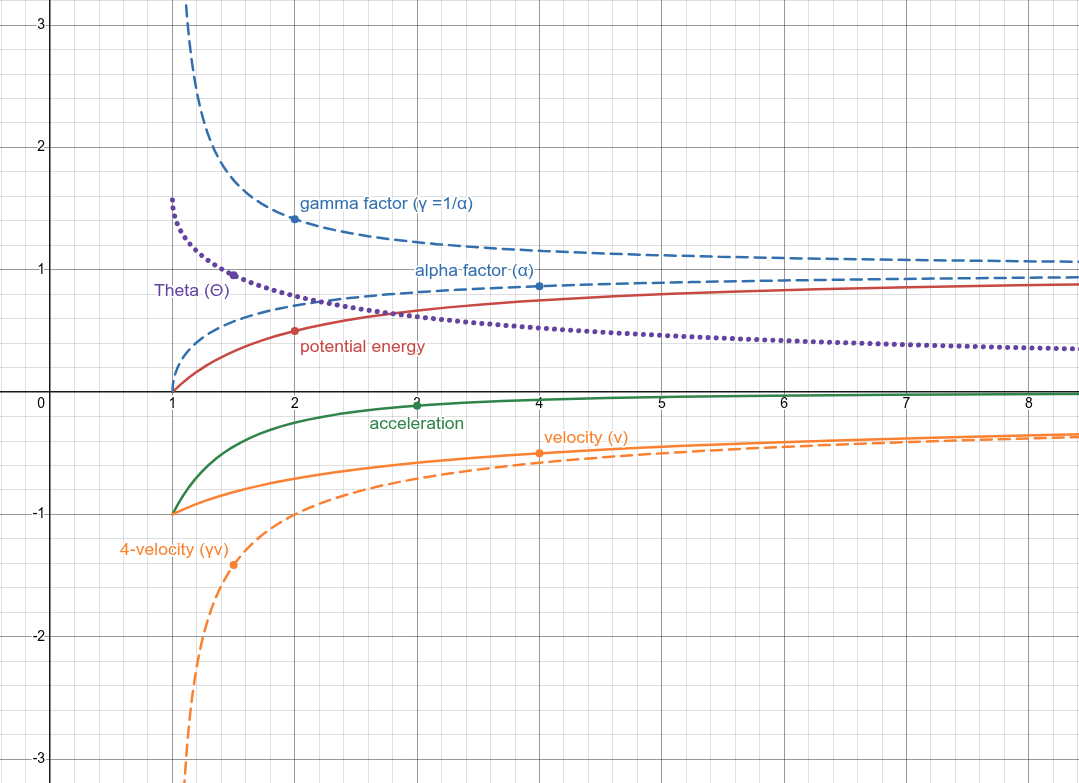
Where do these curves come from? For starters, gamma (γ) is the inverse of alpha (α).
The only important thing is energy. When anything withdraws energy from the potential energy field, the field is displaced downwards. The deformation propagates at the speed of light in the form of 1/r. The alpha factor is determined by the square root of 1/r. Velocity is determined by alpha.
Particles have an internal energy gradient that determines their velocity by way of their alpha factor. Four-velocities (I’m referring to the spacial component, γv) add, not velocities. This is a proxy for adding energies levels. Notice that the 4-velocity reaches -1 at r=2. That’s where two particles (or black holes) would collide, since each has a radius of 1.
Mass is energy (E = mc²). More massive particles use more energy, therefore they deform the potential energy field more. Therefore they have a higher alpha. This means more massive particles inherently travel more slowly through time than less massive ones.
The angle Theta is a useful tool. Sin Θ = velocity. Cos Θ = α. Tan Θ = 4-velocity.
Simple formulas. Simple graphs. Profound implications.
But what about the weirdness of general relativity, where the faster something goes, the more gravity affects it? That’s simple. As a particle travels along, it adds the field’s energy gradient to its own internal energy gradient. But it adds both the gradient over space and the gradient over time. Time multiplied by the speed of light equals space. For most things that aren’t photons, there is a lot more time than there is space. For photons, time and space are equal. That’s why Einstein computed that the sun’s pull on light passing closely by would be double the Newtonian figure.
This is what physicists mean when they say “space and time are on equal footing” in relativity.
Why aren’t special and general relativity taught this way? Because Lorentz, Einstein, and Hilbert had to make up both the ideas and the math. Therefore, the math they used is the math that has been taught ever since. I only came up with this simplification after years of study and pondering, with numerous errors and false paths along the way. I couldn’t have done it without following the trail these great men blazed over a century ago.
Making things complicated is easy. Simplifying things is extremely difficult.

No comments:
Post a Comment
I reserve the right to remove egregiously profane or abusive comments, spam, and anything else that really annoys me. Feel free to agree or disagree, but let's keep this reasonably civil.