Showing posts with label Physics. Show all posts

Saturday, September 12, 2026

Quantum Madness

There is something in the teaching of quantum theory that drives people mad. It makes them unable to think coherently. A scientist can be going along, making perfect sense, then he gets to Bell’s theorem, and the train of rational thought immediately derails.

This video is the perfect example. The scientist has spent the previous 5 hours (this is the second video in the series) explaining how Einstein was correct about the explanation of quantum theory must be incomplete, because it is nonlocal. And then he explains how Bell was trying to explain Einstein’s argument about nonlocality, and used Bohm’s inherently nonlocal1 Pilot Wave theory to show how tests of quantum spin could show the “inherent” nonlocality of quantum behavior. And that’s how we get to this nonsensical chart. The chart is of tests of spin by entangled (opposite spin) particles tested by both Alice and Bob, who can each set up their detectors to align vertically, or be offset by 60 degrees.

The chart is pure gibberish. Aside from the two central lines, where coin tosses are made for “Alice 0”, and then the opposite result is shown for “Bob 0”, the data in the chart is utterly meaningless. Because the chart is conflating completely separate measurements, and jamming them all together.

You can have the central chart, where both Alice and Bob have their detectors aligned vertically. Their detections will always be opposites - down with up, and up with down. Perfect anti-correlation. This is not because of any “spooky action at a distance.” It is because, from the moment the particles were entangled, they held spin properties that were opposites - 180 degrees out of phase with each other. We don’t know what the baseline phase is, though. That’s the job of the detectors to find out. Which they do in an incredibly crude way - by making each particle go either up or down. It’s like taking a spinner from a child’s game, spinning it, and then declaring that if the pointer lands anywhere between 0 and 179 degrees, it points east, other wise it points west. Are we supposed to be surprised that the opposite end of the spinner points the other direction after each random trial?

The rest of the chart, though… is deliberately deceitful. He took coins, and flipped them, changing 25% of the answers from the “0” case for Alice and Bob. This is because, when misaligned by 60 degrees, detections will disagree from the expected (no offset) values 25% of the time. This is perfectly normal wave behavior, as defined by cos²(θ/2). So what we need is not one chart with four lines, but three separate charts, each with two lines - Alice compared to Bob at A0:B0, A+60:B0, and A0:B-60. (You can do even more charts if you want to turn the detectors the other way, but you’ll get similar results.)

And then we get to the “kill shot”. The scientist explains that at 120 degrees offset, A+60:B-60, the detections will disagree with the predicted (zero offset) values 75% of the time. And yet, his chart says they can only disagree half the time. Proof! Quantum behavior is nonlocal!

Well, no. That’s not what his chart says at all. If it did, it would disprove the very quantum theory that was used to create the chart. What he is saying is literally nonsensical - it makes no sense. Because you can’t make two separate 60 degree offset tests, and combine them to create one 120 degree offset test. That’s not how wave behavior works.  A+60 and B-60 have nothing to do with each other!  There is no causal correlation between them at all!  Should we really be surprised that a naive comparison between them disagrees with well established theory and practice?

To make 120 degree offset tests, you have to hold one detector steady and turn the other one 120 degrees, then make your measurements. Count up the detections, and voila! You will find that 75% of the time, they disagree from perfect anti-correlation. (They’re opposites, after all.)

So, you need two new charts, each of two lines - A0:B-120, and A+120:B0. Once you do that, you’ll find a 75% disagreement. Exactly what basic wave theory predicts, whether the particles somehow “magically” influenced each other instantaneously, or whether the two particles were simply created with opposite properties, which you are now measuring for the first time.

Bell’s theory is logically incoherent. Bell’s inequality proves nothing more than that a cosine wave and a triangle wave are different. Well, duh! Nobody sane claims they are identical in the first place. But then again, those brainwashed and gaslighted by the Copenhagen interpretation can’t quite be said to be truly sane any more, as they must hold logically contradictory “facts” in their minds.

QED

Copenhagen interpretation delenda est!

1

Huh. I never heard about this part before. You learn something new every day.

Thursday, August 20, 2026

The geometry of energy and the conservation of rest mass

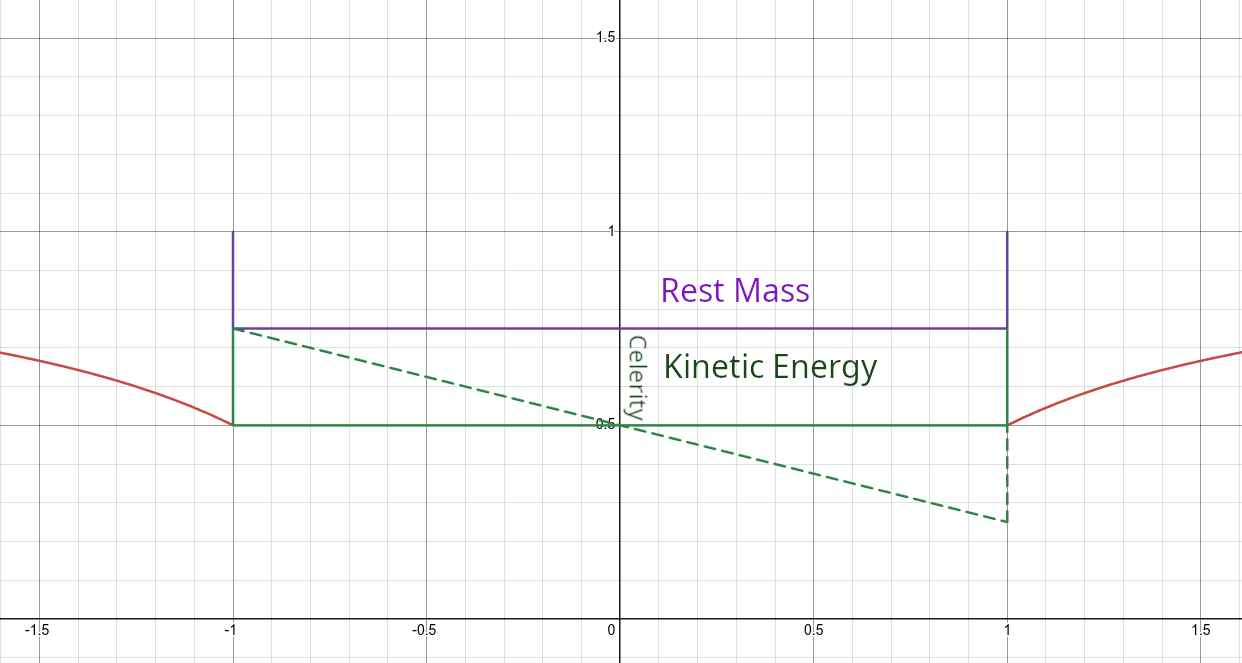
Here is the reference particle drawing for this lesson. It has a rest mass of 0.25 max, and is moving to the right with a celerity of 0.25. That makes the green triangle angle relative to the purple rest mass an angle of just over 14 degrees, which gives it a velocity (to the right) of about 0.2425 the speed of light. That gives it an alpha factor (perceived passage of time) of just over 0.97, the inverse of which is a gamma factor of just a bit over 1.03.

What is celerity? It’s what you add instead of velocities in relativity. It’s really just the tangent of the angle for which sine is the velocity and cosine is the alpha factor. It’s also velocity divided by alpha, which is equivalent to velocity times gamma.

By PAR - Own work, CC0, https://commons.wikimedia.org/w/index.php?curid=66751798

The first thing to understand about these diagrams is that the vertical axis represents energy. So celerity is a direct measure of energy. So is mass. Unlike kinetic energy (KE = ½mv²), mass (E = mc²) is not halved.

The second thing to understand is that alpha is a horizontal scaling factor. It’s not correctly drawn here, because that’s hard, but you get the idea. As a particle speeds up, it shrinks side to side. Or at least it does from the perspective of other particles not moving along with it. It, of course, always thinks it’s stationary.

The third thing to understand is that the rest mass is conserved. What does that mean? It means the area remains constant. As celerity increases, the vertical leg of the mass rectangle increases in direct proportion to gamma. But the horizontal leg, decreases directly in proportion to alpha. The area remains constant because a scaling factor of α * 1/α = α/α = 1. Thus, even as the apparent mass energy increases by gamma, the rest mass remains constant.

The kinetic portion of the total energy ends up being the area of the dashed green triangle, shown above by the solid green rectangle. If you take half of that, you get the velocity, by no coincidence at all.

What’s the point of the green dashed lines below and above the total energy level? Those represent internal energy differentials due to the motion of the particle. This is where blue and red shift come from. Compared to the baseline of a particle sitting motionless, or directly to the side of a moving particle, a photon emitted forwards gains energy. A photon emitted rearwards loses energy.

QED

And as always, Copenhagen interpretation delenda est!

Tuesday, August 4, 2026

Relativistic Doppler Shift

The standard formula for relativistic Doppler shift is: 

√((1 + v/c)/(1 - v/c)).

This multiplication factor describes the stretching out of wavelengths (reduction in energy) for light emitted from a body moving directly away from you, or the increase in the frequency (increase in energy) of light coming directly towards you. In this model, a positive velocity is moving away from you, and negative one towards you. To get the factor for frequency instead of wavelength, negate the signs for the velocity or take the inverse of the output.

For a body moving away you at 0.5c, a photon’s wavelength will increase by a factor of 1.732051. For a body moving towards you at the same speed, a photon’s frequency will increase by the same factor.


How does this work in the geometry of the particle model of gravity and motion? The factor for the wavelength of a particle moving away you (thus, decreasing in energy) is determined by taking the gamma factor (the stretching out of time, showing energy loss for a photon) and adding the inertial energy of the particle: 

1/cos(asin(v)) + tan(asin(v)).

The get the factor for the wavelength of a particle moving towards you (increasing energy), subtract the energy from the gamma factor. Remember, a wavelength factor smaller than one shows an increase in energy.

To get the factor for frequency instead of wavelength, reverse the sign or take the inverse of the output. This really makes sense, because a photon’s frequency is directly related to its energy. It makes sense that a high gamma factor, showing a reduction in the perceived time of the source, would reduce the energy of any photon it emitted (regardless of direction), just as its inertial energy in your direction would add to that photon’s energy, and reduce it when traveling away from you.

QED

And as always, Copenhagen interpretation delenda est!

Friday, July 31, 2026

Relativistic energy addition

One of the “oddities” of special relativity (SR) is that velocities don’t add in the way you would expect. Given a relativistic pirate ship traveling at 0.2c from your perspective (v), firing a cannonball straight forward at 0.3c from its perspective (u’), how fast do you see the cannonball moving (u)?

The SR formula for the addition of two velocities v (your perspective) and u’ (their perspective) is: u = (v + u’)/(1 + vu’).

Plugging in the numbers, we get u = 0.471698c.

How does this work with my particle and energy model of gravity and motion? Perfectly well, once you consider the geometry (well, trigonometry) of the situation.

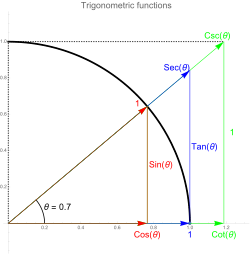
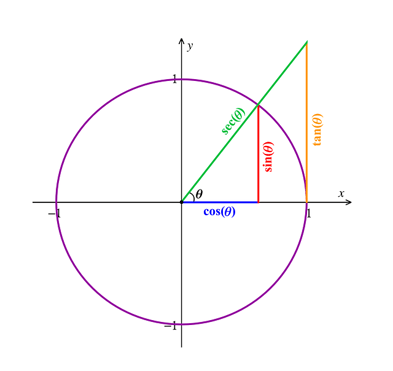
Here, as a reminder, is the handy diagram of trig identities.

https://blog.prepscholar.com/verifying-trig-identities

In special relativity, the speed of light is always constant and defined as one. That lets us use the trig circle to define terms in a different way. Since the hypoteneuse is c (1), velocity is sine and time dilation (Lorentz alpha) is cosine. (This is the fundamental principle of SR.) Since every particle is the exact same size, energy, velocity, and acceleration are all related, with energy being equivalent to the tangent (sin/cos) of the angle. Remember, only energies are real. Everything else is derived. But we can’t see energy, so we are usually forced to do things backwards.

So, how do we add energies in a geometric way using this knowledge? Carefully, with an eye towards the definitions. We know the velocities (sines). That gives us the time dilations (alphas). That gives us the energies. But we have to remember that the cannonball’s time dilation is measured from the ship’s time dilation. Just like you cannot directly add the velocities, you cannot directly add the energies.

The velocities (sin) add. The time dilations (cos) multiply. Energy (tan) is total velocity divided by total dilation. That’s the secret to relativistic energy addition.

Given the ship’s velocity from your perspective (v) and the cannonball’s velocity from the ship’s perspective (u’), we can define angles x and y such that x = arcsin(v) and y = arcsin(u’). We want to find the velocity of the cannonball from our perspective (u).

The definition of tangent: tan(a) = sin(a) / cos(a)
The relativistic addition of energies: tan(z) = [sin(x) + sin(y)] / [cos(x) * cos(y)]
u = sin(atan(z))
u = sin(atan( [v + u’] / [ cos(asin(v)) * cos(asin(u’)) ] ))

Plugging in our numbers for v = 0.2c and u’ = 0.3c, we get x = asin(0.2) and y = asin(0.3). That gives us tan(z) = 0.534951, so u = 0.471698c.

QED

And, as always, Copenhagen interpretation delenda est!

Saturday, July 25, 2026

The source of gravity, inertia, and time

Let’s begin with the formula. We assume there is a field of potential energy, from which all other energies are withdrawn. It has a large but finite constant value (U₀) at every point. The potential energy at a point outside a particle is the total potential energy minus the total energy of the particle (E) divided by the distance (r) from the particle in relation to the radius of the particle (r₀).

U = U₀ - E(r₀/r), where r ≥ r₀.

If we take the gradient (slope) of this curve, we get acceleration, which we call gravity. The instantaneous acceleration (over the minimum possible time, t₀) at a point is a velocity, as a fraction of the speed of light. This determines the Lorentz alpha factor at that point, which is the subjective passage of time. The faster you go, the slower you perceive time passing. Perceived time is to speed as cosine is to sine. (This is the fundamental relationship of Special Relativity. Yes, it really is just the Pythagorean Theorem.)

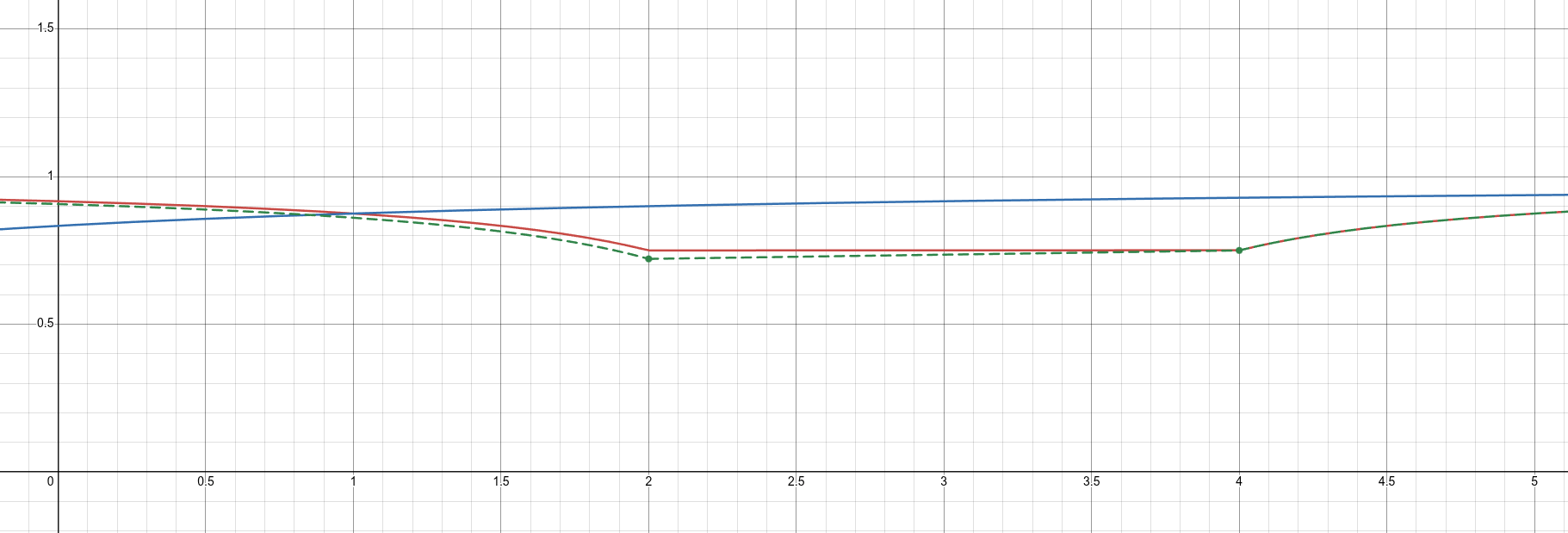
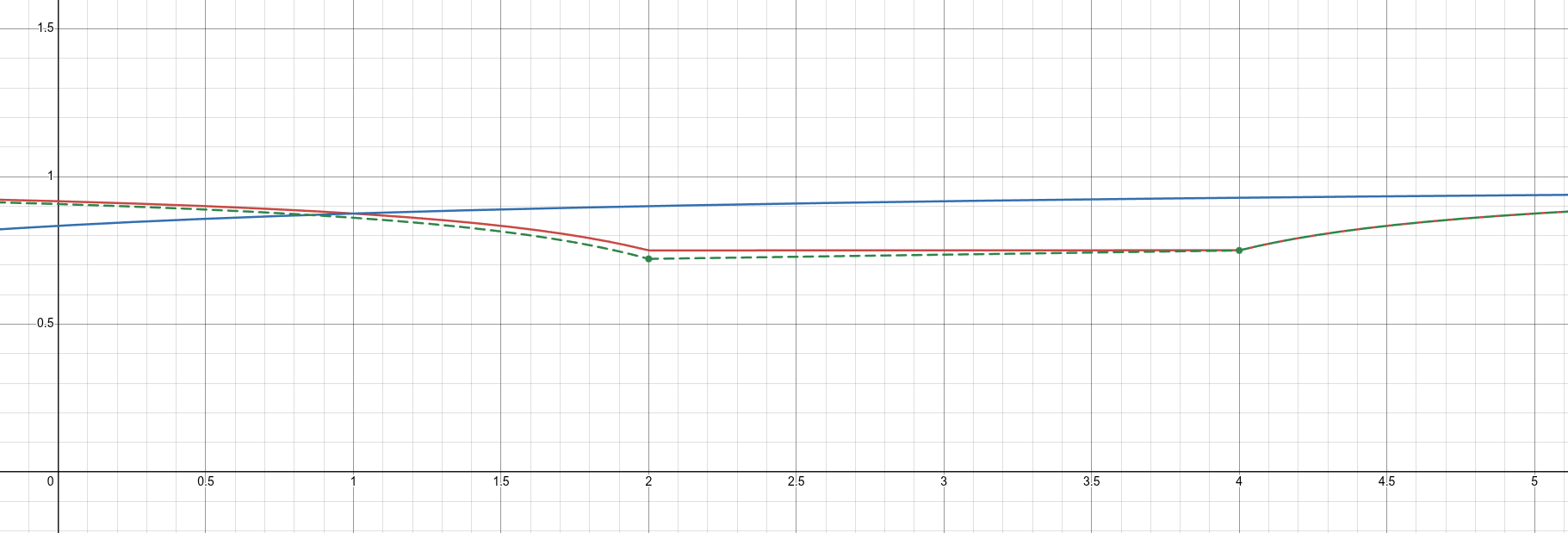
The energy gradient inside a particle ( a fixed amount unless altered by external gradients) is the particle’s own velocity (instantaneous acceleration), which determines its alpha factor. Below we have a stationary (red) particle of mass energy 0.25U₀ being accelerated to the left (dashed green) by an external gradient (blue).

Notice the blue curve is not affected by the particle at all. Locally, energy is not conserved. (However, our test particle creates a gradient which accelerates the particle causing the blue curve, so the total system balances.) Also notice how the acceleration is not influenced by the particle’s own mass/energy. Drop a feather and a hammer on the airless moon, and they both fall the same way.

Notice also that the particle is accelerated by the external gradient, but then retains this acceleration. This is why the Schwarzschild equation has two factors in the direction towards the attractive body: one for time (enormous, but decreases with speed), and one for space (minuscule, but increases with speed). Time flows much, much faster than distance does for relatively slow moving bodies, so the accumulated acceleration is much, much more of a factor than the instantaneous push of local acceleration. Light has double the expected curvature near the surface of the sun because it’s travelling distance r₀ in time t₀, so the internal and external accelerations are equal. Mercury orbits the sun a tiny bit faster than expected because it’s traveling so very quickly, and even more quickly nearest the sun. Also, the gradient across the diameter of a particle is always greater than at the central point. However, this difference is only really noticeable as you get close to the attractive body and the slope increases. Newton was fooled by the small angle approximation, which holds in everyday experience.

A highly observant reader might notice that these curves are somewhat different from the accepted values in General Relativity. (At the surface of the Earth and Sun, the values predicted differ at the ninth non-zero digit, a quantity several orders of magnitude smaller than current measurement errors.) Schwarzschild based his equation on the escape velocity of a particle approaching a body. At r = 1, this can be greater than the body’s own energy, which is nonsensical. However, the accelerated particle reaches the speed of light at distance r = 2 from a black hole mass, at which point the two particles impact each other (each having a radius of 1) and stop, there being no more energy to draw from. (You can’t have less than zero energy remaining in the field.) So, it’s not actually a contradiction. It’s merely incorrect to assume the energy of a body can be more than the actual energy of the body, and that the energy of a body can be more than the available energy. To give him credit, the concept of fields had yet to be invented, and energy still isn’t a well defined concept more than a century later.

Yes, every particle has the same radius r₀, with an inside and outside separated by a discontinuity. Why? Because Planck and Heisenberg said so. So does the geometry of 1/r, its derivative, and its integral. When combined with the finite total energy of U₀, this prevents infinities and singularities. A black hole is a thin region of maximal energy density surrounding a spheroid of zero potential energy.

You might have noticed the energy gradient (units: kg m²/s²) is being measured over a distance (m) in a time (s).  That gives momentum (kg m/s).  The mass (kg) is somewhat unimportant, as we convert it directly to energy (E = m c²).  It has no gradient, but it does take up an important amount of space, defining the size and shape of a particle!  And empty space has no mass, and thus no momentum.  So we can redefine energy (anyrgy?) for our purposes to ignore the kilograms and be simply m²/s².  

Empty space has energy gradients, and given the fixed speed of light and the fixed size of a particle, these gradients directly correlate to velocity.  However, we aren't truly adding velocities.  We are adding energy gradients.  They're not the same thing, although they appear to be at low energies.  The small angle approximation strikes again!

What are U₀, r₀, and t₀? I don’t know. A good guess is that they are based on the Planck units. If so, then U₀ ≈ 1.9561×10⁹ J, r₀ ≈ 1.616255(18)×10−35 m, and t₀ ≈ 5.391247(60)×10−44 s.

Tuesday, June 16, 2026

Random means "We have no idea."

What quantum mechanics leaves out of its "randomness is fundamental" picture is the state of the entire rest of the universe.  Equations for quantum states generally cover only one or a very low number of particles, interacting (or not) with a very limited environment.  The equations leave out the near-infinitude of states required by the generator to create the particles in question.  They completely ignore the near-infinitude of states required for the detector to function.  They ignore as irrelevant the near-infinitude of states of the surrounding apparatus.

Why?  Because the math is much, much too hard, and the measurements are essentially impossible to make to the precision required.  Therefore, "randomness is fundamental to the quantum mechanical process!"


Copenhagen Interpretation delenda est!

Friday, April 24, 2026

How light bends, and other oddities

Einstein’s first prediction for general relativity was that light from distant stars passing closely by the sun during a total eclipse would bend twice as much as Newton’s laws of gravitation and motion called for. (No, this has nothing to do with the eclipse. That’s just the only time you can see things near the sun.) Many observations over the past century have proven him correct. By why does light do this?

Since the days of Newton, we have measured the attractive force of gravity quite precisely. The motion of the moon around the earth, the orbits of the planets about the sun, the falling of apples from trees, these are all data points rigorously collected, compiled, and compared. They all show the same force of gravity acting on massive objects. Well, they almost all do…

Mercury moves just a bit too quickly as it passes close by the sun. This advances its orbit just a tiny bit each revolution. There was no simple explanation for this. It was as if the carefully studied force of gravity changed when you got too close to the sun. Einstein invented general relativity in part to solve this conundrum.

Light from distant stars passing close by the sun during an eclipse was the earliest proof his theory was correct, or at least worked properly, which is generally the same thing. But why does light do this? The answer, as almost always, lies in the geometry. To the graph!

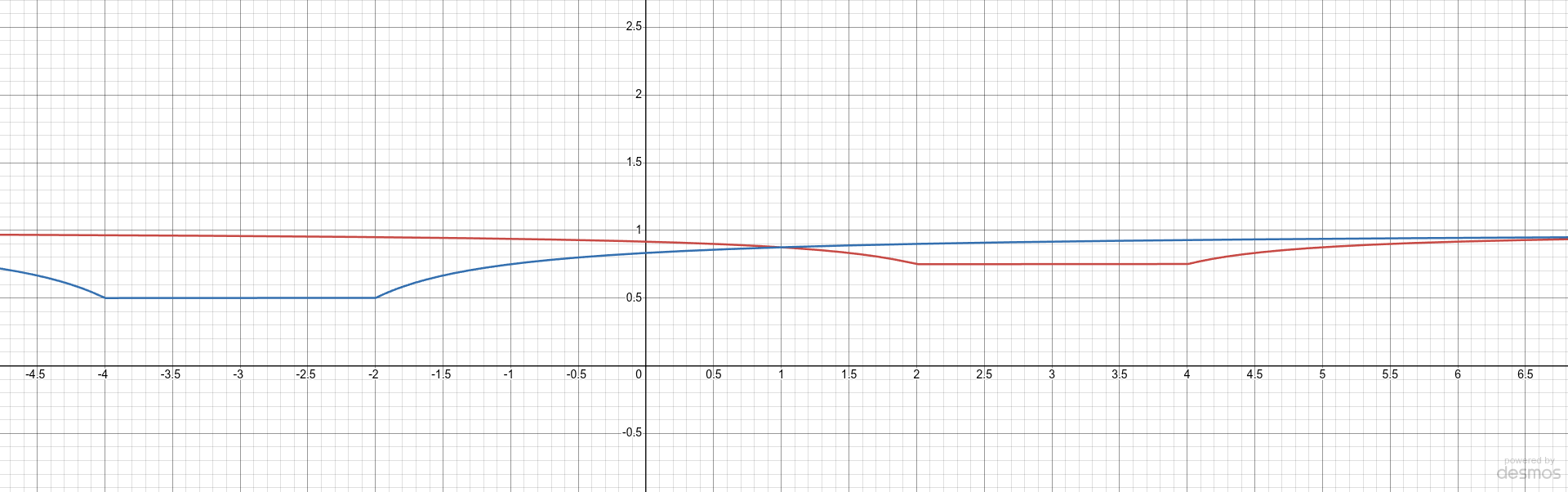
Here we have two test particles in the potential energy field, held motionless by the magic of wanting a simple example. The blue one on the left has a mass of 0.5 (the Planck mass = 1 in this model). The red one on the right has a mass of 0.25. They are close to each other, with one centered at -3, the other at +3. Each is, of course, of radius one, as are all particles regardless of mass. Once we release the less massive particle on the right, what happens to it?

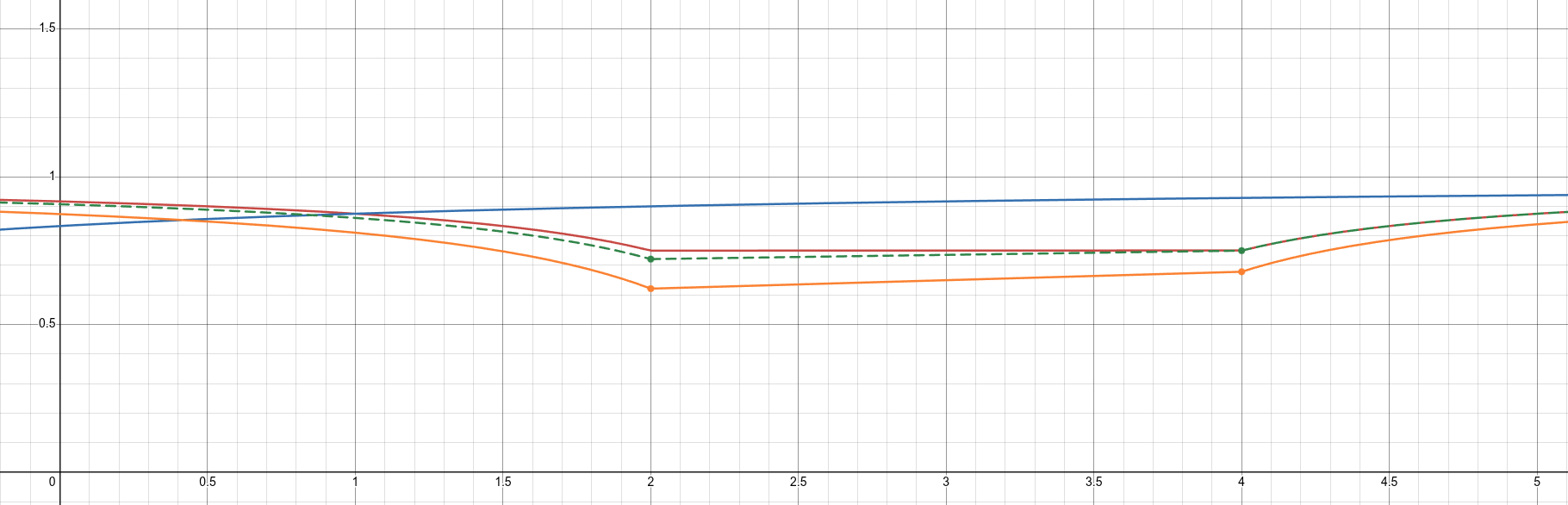
The particle gains an internal energy gradient equal to the gradient of the ambient field inside its boundaries. This internal gradient grants it a velocity in the direction of the lower level of the field, towards the left. The internal gradient is now a permanent part of the particle’s energy profile, shown as dashed green. Well, permanent until the next moment in time, that is. Then the particle will once again gain an internal gradient equal to the gradient of the background field. This works almost like compound interest. As long as time keeps moving forward and the particle keeps moving, the internal gradient (the particle’s kinetic energy) will continue to change. This grants a steadily increasing velocity leftwards, toward the other particle. This is exactly as we expect and Newton so ably described.

But wait, there’s more! Notice that the particle taking energy from the gradient didn’t remove any energy from the gradient. It never does. That’s the trick Newton missed. The background gradient, upon which our humble test particle resides, remains a temporary and very localized modifier to the particle!

The gradient of the orange version of the particle is now doubled - but only while the particle is in this spot. Its internal energy gradient has not changed. That changes with time, which always advances at the speed of light. The modifier changes with position, which is to say distance. Slowly moving objects accelerate more slowly, since the time factor massively outweighs the distance factor.

  • Time for a particle moving along a gradient adds kinetic energy to the particle.

  • Distance for a particle moving along a gradient grants temporary velocity.

These simple rules explain why the perihelion of Mercury precesses too quickly around the sun, why light bends twice too much when passing close by the sun. The faster something moves, the more the temporary velocity boost of distance matters. This effect works with the particle’s velocity as a fraction of the speed of light. Light, moving exactly equally through both space and time, experiences equal effects from both.

What we have measured over the years with our relatively low speeds and feeble gravity around the earth is the compound interest of time. We ignored the simple fee of distance, because it disappeared as a minute rounding error. Remember, in the graphics above, a mass of one crates a black hole. Most particle masses are well below that, creating truly minute gradients. Especially seeing as most of the time, particles are incredibly far from each other at this scale.


An important note about this model: You’ll notice that both particles have radius one. This is true of all particles, regardless of mass/energy. Particles are not truly point-like. They have fixed sizes, even though this size is incredibly small. Particles are discontinuities in the field. They have an inside and an outside. You cannot get infinitely close to a particle without running into it. There are no infinities. There are no singularities.

The fixed radius of a particle has another effect. A slowly moving particle can gain energy from the same background multiple times because of the overlap. The more slowly it moves, the more quickly it will gain kinetic energy from the same background gradient. This, in effect, “flattens out” the force of gravity at great distances for slow speeds. This may help explain some of the effects attributed to dark matter.

Another effect of the field is that the particle’s total energy at that point in the field determines the rate at which time passes for it - the Lorentz alpha factor of time dilation. The lower you sink into the field, the more slowly time passes for you. It’s not just the gradient - it’s also the depth. A particle using up all the available energy would subjectively experience no time passing, or an alpha factor of zero.