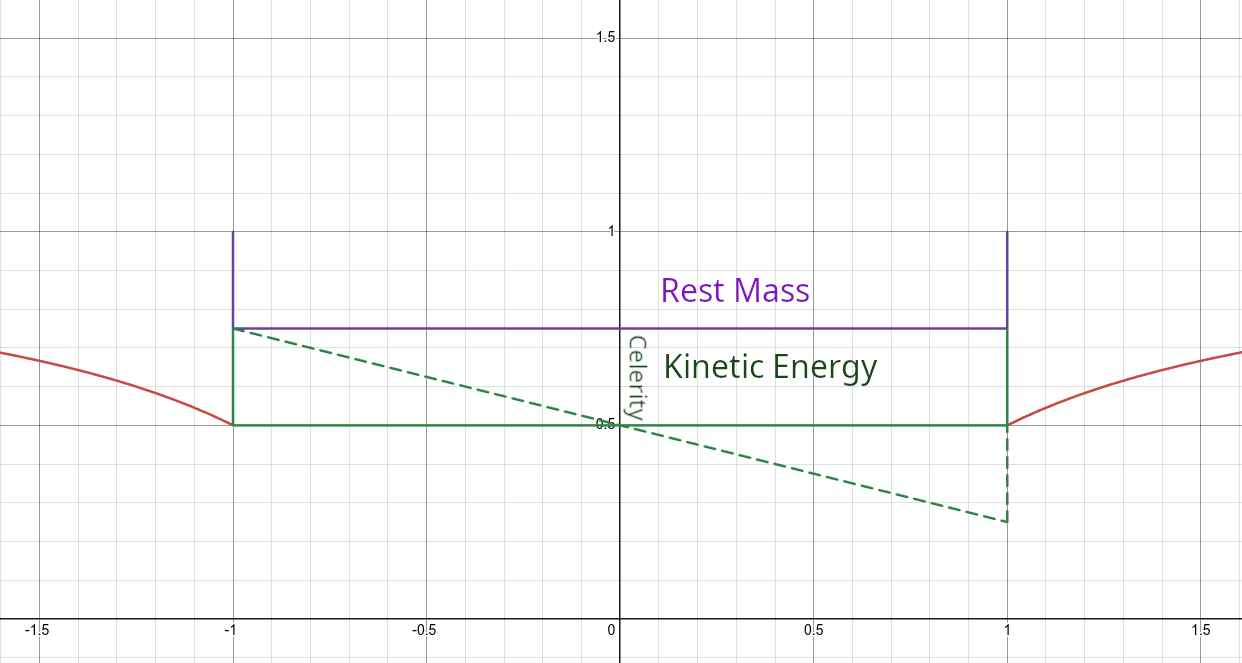
Here is the reference particle drawing for this lesson. It has a rest mass of 0.25 max, and is moving to the right with a celerity of 0.25. That makes the green triangle angle relative to the purple rest mass an angle of just over 14 degrees, which gives it a velocity (to the right) of about 0.2425 the speed of light. That gives it an alpha factor (perceived passage of time) of just over 0.97, the inverse of which is a gamma factor of just a bit over 1.03.
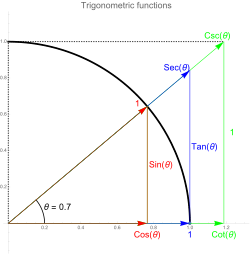
What is celerity? It’s what you add instead of velocities in relativity. It’s really just the tangent of the angle for which sine is the velocity and cosine is the alpha factor. It’s also velocity divided by alpha, which is equivalent to velocity times gamma.
The first thing to understand about these diagrams is that the vertical axis represents energy. So celerity is a direct measure of energy. So is mass. Unlike kinetic energy (KE = ½mv²), mass (E = mc²) is not halved.
The second thing to understand is that alpha is a horizontal scaling factor. It’s not correctly drawn here, because that’s hard, but you get the idea. As a particle speeds up, it shrinks side to side. Or at least it does from the perspective of other particles not moving along with it. It, of course, always thinks it’s stationary.
The third thing to understand is that the rest mass is conserved. What does that mean? It means the area remains constant. As celerity increases, the vertical leg of the mass rectangle increases in direct proportion to gamma. But the horizontal leg, decreases directly in proportion to alpha. The area remains constant because a scaling factor of α * 1/α = α/α = 1. Thus, even as the apparent mass energy increases by gamma, the rest mass remains constant.
The kinetic portion of the total energy ends up being the area of the dashed green triangle, shown above by the solid green rectangle. If you take half of that, you get the velocity, by no coincidence at all.
What’s the point of the green dashed lines below and above the total energy level? Those represent internal energy differentials due to the motion of the particle. This is where blue and red shift come from. Compared to the baseline of a particle sitting motionless, or directly to the side of a moving particle, a photon emitted forwards gains energy. A photon emitted rearwards loses energy.
QED
And as always, Copenhagen interpretation delenda est!

No comments:
Post a Comment
I reserve the right to remove egregiously profane or abusive comments, spam, and anything else that really annoys me. Feel free to agree or disagree, but let's keep this reasonably civil.