Saturday, August 9, 2025

Where Einstein and I differ

I have a new post up on Substack about how my model of gravity and motion differs from Einstein's relativity.  Go there to see the whole thing, because Blogger still doesn't work well with LaTeX.  Here's the summary.


I’ve been doing the numbers on my model of the potential energy field and objective gravity. It took me an embarrassingly long time to figure out how to convert my geometric methods to the algebraic ones of special relativity. But, I now have a much clearer idea of how my model works, what the calculations mean, and where Einstein and I disagree. It mostly comes down to, “What are you measuring, and how are you measuring it?” Einstein, in effect, conserves velocity at the expense of momentum and energy. I conserve momentum and energy at the expense of velocity. Einstein’s choice leads to ever increasing complexity. My choice leads to more simplicity and a model that predicts behavior on the fringes more accurately.

Isn’t my way more complicated? Yes. Don’t the numbers come out slightly different compared to special relativity? Yes. So why bother?

Doing things my way creates an intuitive model of particles moving in a field. Doing things my way preserves Euclidean space and time, the conservation of momentum, and the conservation of energy, while also preserving the observation of the speed of light as being the same in every reference frame. It shows how momentum actually works as an energy gradient across a particle of fixed width. It shows that momentum, kinetic energy, and gravity all have the exact same source - energy gradients. It shows that rest mass is a fixed and flat energy addition to a particle. It shows that a particle’s mass and kinetic energy are irrelevant to the forces acting upon it, so gravity attracts all objects equally. (The interaction of particles with each other generates the traditional force laws.) It shows how red and blue shift happen. It ensures that no massive particle can ever reach or exceed the speed of light. It eliminates both infinities and singularities. It shows that a change of reference frame is a literal rotation of a gradient angle. It shows that subjective (“proper”) time is an inherent feature of every massive particle. It shows that your perception of space and time is exactly that - your subjective perception.

It also correctly predicts a “flattening” of gravity at the low & slow regime near the edges of galaxies - something general relativity completely fails at.

Einstein created a model of how things seem to be. I have created a model that appears to show how things really are.

Monday, August 4, 2025

The simple inverse (a correction)

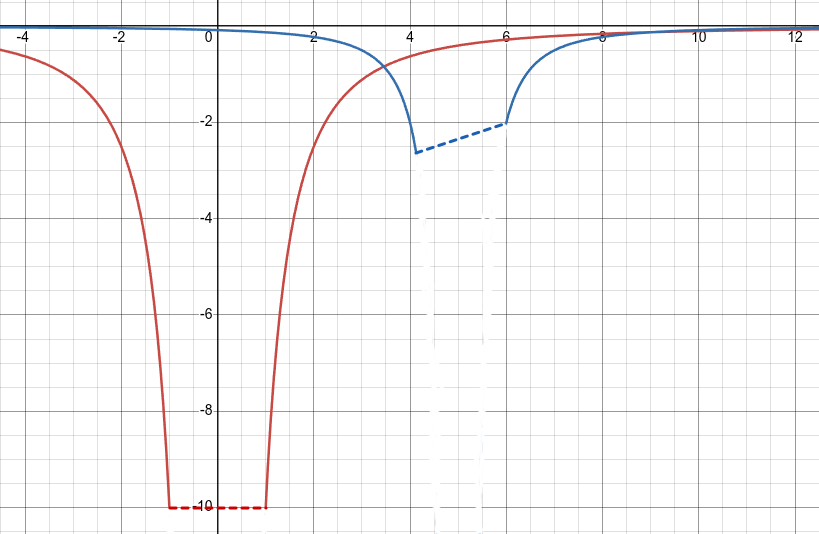
I need to make a short but crucial correction. I’m human (so they say), and subject to the same force of habit as everybody else. I’ve been wrong about the curvature of the potential energy field. It curves as 1/x, not 1/x². If the force of gravity follows an inverse square law, then the curvature that causes it must be the simple inverse. Duh. Why did it take me this long to notice? I had to start running the numbers to see that I kept coming up with an inverse cube force to see the problem. Now, all my diagrams are wrong.

Symmetry at work: The classical gravitational force (inverse square) is the derivative of the curvature (inverse) of the potential energy field. The gravitational potential is the integral of the force. That means the classical gravitational potential is the curvature of the potential energy field is the simple inverse.

To see the near and far field formulas for the gravitational attraction and gravitational potential to a stationary particle, you have to see the original post on Substack.  Stupid Blogger doesn't have LaTex support.


Saturday, August 2, 2025

Replacing relativity with high school trig

The potential energy field model of objective gravity and inertia is simple and coherent. Inertia and the force of gravity are the same thing - energy gradients of a particle and of the field, respectively. We can compute their interactions with high school math.

Here is a comparison of classical versus relativistic formulas and outcomes, to show where Newton quite understandably went wrong. Throughout, θ is the gradient angle, and speeds are measured as a fraction of c, the speed of light. All calculations are for collinear motion to simplify and clarify.

Classical acceleration:
sfinal = sa + sb
0.5c + 0.75c = 1.25c
0.5c - 0.75c = -0.25c

Relativistic acceleration:
sfinal = sin(atan(tan(asin sa) + tan(asin sb))) = sin(atan(tan θa + tan θb))
0.5c + 0.75c = 0.863c
0.5c - 0.75c = -0.486c

Classical relative motion:
sapparent = sthem - syou
0.75c - 0.5c = 0.25c
-0.75c - 0.5c = -1.25c

Relativistic relative motion:
sapparent = sin(atan(tan(asin sthem) - tan(asin syou))) = sin(atan(tan θthem - tan θyou))
0.75c - 0.5c = 0.486c
-0.75c - 0.5c = -0.863c

With this new relativistic formula, it is mathematically impossible for a massive particle to ever reach the speed of light. (Photons have neither a mass nor a gradient.) Since all particles have a fixed width, the gradient angle can never reach the vertical. The speed of a particle is determined by the sine of the gradient angle. The tangent of the angle is the gradient, the change in energy levels across the particle.

This doesn’t really do anything much different from special relativity. It just does it from the starting assumption that there is such a thing as objective time and flat, Euclidean space. Plus, it uses the exact same formula for gravity (once you figure out the energy gradients), so it is much simpler than general relativity.

QED

Tuesday, July 29, 2025

Eliminating the need for dark matter.

I really need to give my model of the laws of motion a name. The potential energy field is a good description, but not really a catchy name. How about “objective gravity”? Because that’s what it is. There’s really nothing relative about it. The strange effects of relativity are, after all, subjective. Of course, we can’t escape from our own subjective experience to see it from outside, so there’s that. But still, it’s handy to have a model that works well and actually makes sense when you look at it.

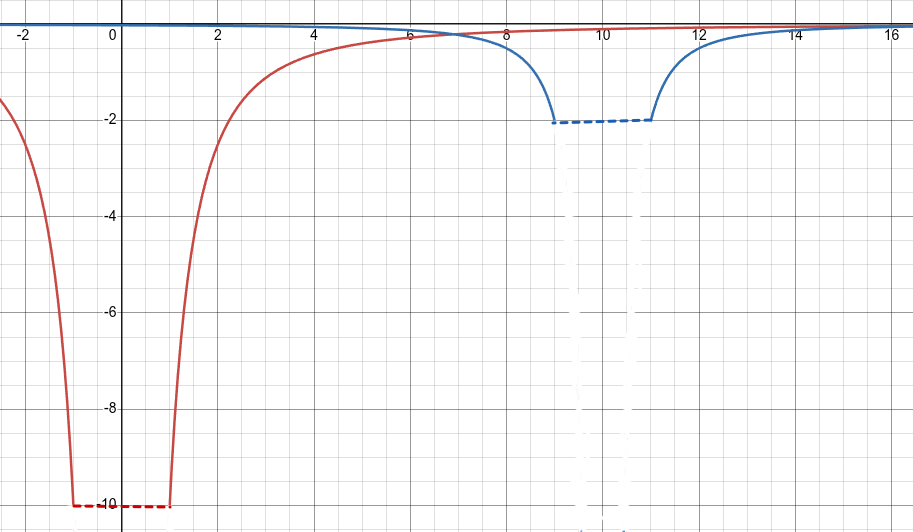
Once again, the potential energy field with a couple of particles doing their thing.

Something I noticed this morning was how the model obviates the need for dark matter (in most cases). Dark matter was theorized because neither Newton nor Einstein can account for the rate of rotation near the outer edges of galaxies. The stars are just moving too fast for the amount of matter visible in the galaxy. It’s as if either there were extra, invisible matter, or the force of gravity was stronger than predicted at the weak field limit.

Well, guess what our simple model does? It always predicts a slightly stronger force of attraction than Newton, and usually predicts a force similar to Einstein’s general relativity. The exception being adjacent to or inside the event horizon of a black hole, where objective gravity doesn’t have any infinities or singularities. In other words, it predicts a sensible and sane universe. (Don’t forget the potential energy field has a bottom that you can’t go below, just like it has a top you can’t rise above.) But how does it predict an extra or flattened force at the weak limit?

See those particles? They’re not points. They have a fixed size. Every particle has the same size, no matter what it is, no matter its mass, no matter its speed. It’s the only way the math works, and the only way observations show it can work. We know that gravity effects everything equally.

It’s the physical size of a particle that makes all the difference. Newton and Einstein both base their theories on particle being truly point-like. Einstein adds in a fudge factor that I have previously shown is an approximation. Objective gravity doesn’t use the tangent at a point - it uses the gradient across a volume. This will always give a slightly greater force than the tangent at the center point. Unless there is no force at all, of course, in which case it (unlike general relativity) correctly predicts exactly zero.

But wait, there’s more!

That volume takes time to move. The gradient is being constantly integrated as the particle moves along. That means that the slower you go, the more time the same points in the gradient have to influence your motion. Thus, the force of gravity effectively flattens out at the slow/weak limit, even though there is no change in the inverse-square curve. That’s something a point-like particle could never do.

The predictive power of a simple diagram never ceases to amaze me.

Friday, July 11, 2025

The Schwarzschild metric is an approximation

I can't get LaTex commands to work here today, so you get a link to my Substack post.

Summary:  The Schwarzschild metric, so useful in describing the strange behaviors in the vicinity of a black hole, is clearly an approximation.  It is valid neither in empty space (where it shows c² = c² - 1) nor at the event horizon of a black hole (where it fails with a divide by zero error as time goes to zero and space goes to infinity).  This is not an opinion, it is an easily demonstrated mathematical fact.

The error arises from using the precision of calculus where reality is less precise.  The potential energy gradient across a particle with a finite size is not equivalent to the tangent angle at its center.  The steeper the curvature, the greater the differential between the two methods of calculating the force acting upon the blue particle.


Tuesday, July 8, 2025

Neither Safe Nor Effective

"Safe and effective" my ass.  No flu shot has ever been effective at anything other than making otherwise healthy people sick.  We knew at the time the clot shots hadn't been thoroughly tested.  That takes at least a year of human trials.  Then we learned mRNA shots had never worked in any test animal - normally killing them all.  Then we saw people dropping like flies after getting the shots.

And all the while, the government and their pet media kept chanting, "Safe and effective!"

The FDA and CDC had the data showing the clot shots were deadly, and kept silent.

The big pharma companies cooked the books on their trials, then destroyed most of the evidence against them.

And now there's this study, showing with the government's own data that the shots killed.  And they knew it all along.

Sunday, June 22, 2025

A rant against trained stupidity

 Here is a video of two prominent physics YouTubers talking to each other about the problems in fundamental physics, or the fundamental problems in physics. It’s a half hour long, and hosted by the Institute for Art and Ideas.

Watching this leads me to today’s rant. These are intelligent people who have been taught to be stupid. Indoctrination works.

Let’s begin with Bell’s strawman theory, AKA Bell’s inequality. This paper supposedly proves that theories of locally real, “hidden variable” particles are incompatible with experimental results. Balderdash! The paper contains not one but two baseless assumptions.

  1. The paper insists that a “locally real” particle, when measured to have a spin in the “up” direction, is and was 100% up from the moment of creation.

  2. The paper insists that the “locally real” entangled partner particle has a straight (linear) percentage chance, based on degrees off of “down”, of being detected as down. This looks like a triangle wave when plotted.

As Einstein supposedly said, opens paper to proper page and points, “We have no reason to believe any of this is true.”

These assumptions are not made for the particle using standard quantum mechanics. Bell made up these stipulations out of whole cloth. And they have gone mostly unchallenged for 60 years.

The spin of entangled particles is 180 degrees apart from the moment of their (very local) entangling. (90 degrees for photon polarization.) No more, no less. This is true no matter when or where you measure them. No spooky action at a distance required or allowed. We simply can’t know, even in principle, what the direction of spin of a particle is before we measure it. Naturally, our means of measuring the angle of spin alters it.

Measuring a particle depends upon the angle of the measuring device, in a very statistical way that follows a (non-linear) sine curve when plotted. Bell then goes on to decry, Lo, behold the inequality! A sine wave is different from a triangle wave, in an experimentally verifiable way!

The straw man is then beaten repeatedly over the following decades, resulting in the granting of the Nobel Prize to three physicists in 2022.

Millions of dollars and 60 years wasted punching a straw man.