Saturday, July 25, 2026

The source of gravity, inertia, and time

Let’s begin with the formula. We assume there is a field of potential energy, from which all other energies are withdrawn. It has a large but finite constant value (U₀) at every point. The potential energy at a point outside a particle is the total potential energy minus the total energy of the particle (E) divided by the distance (r) from the particle in relation to the radius of the particle (r₀).

U = U₀ - E(r₀/r), where r ≥ r₀.

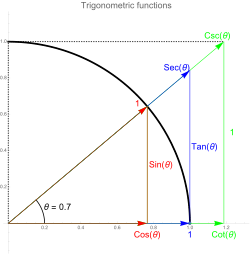
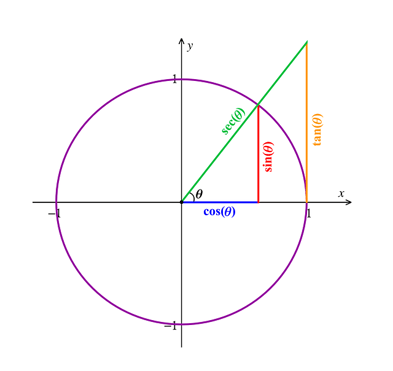
If we take the gradient (slope) of this curve, we get acceleration, which we call gravity. The instantaneous acceleration (over the minimum possible time, t₀) at a point is a velocity, as a fraction of the speed of light. This determines the Lorentz alpha factor at that point, which is the subjective passage of time. The faster you go, the slower you perceive time passing. Perceived time is to speed as cosine is to sine. (This is the fundamental relationship of Special Relativity. Yes, it really is just the Pythagorean Theorem.)

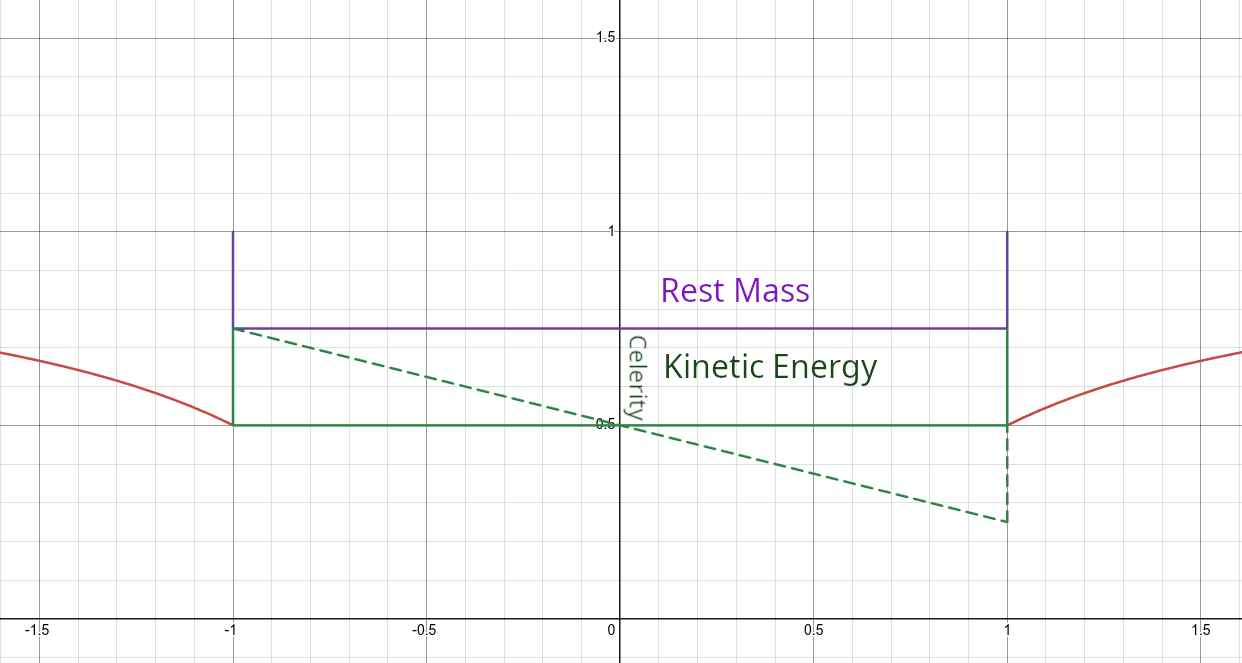
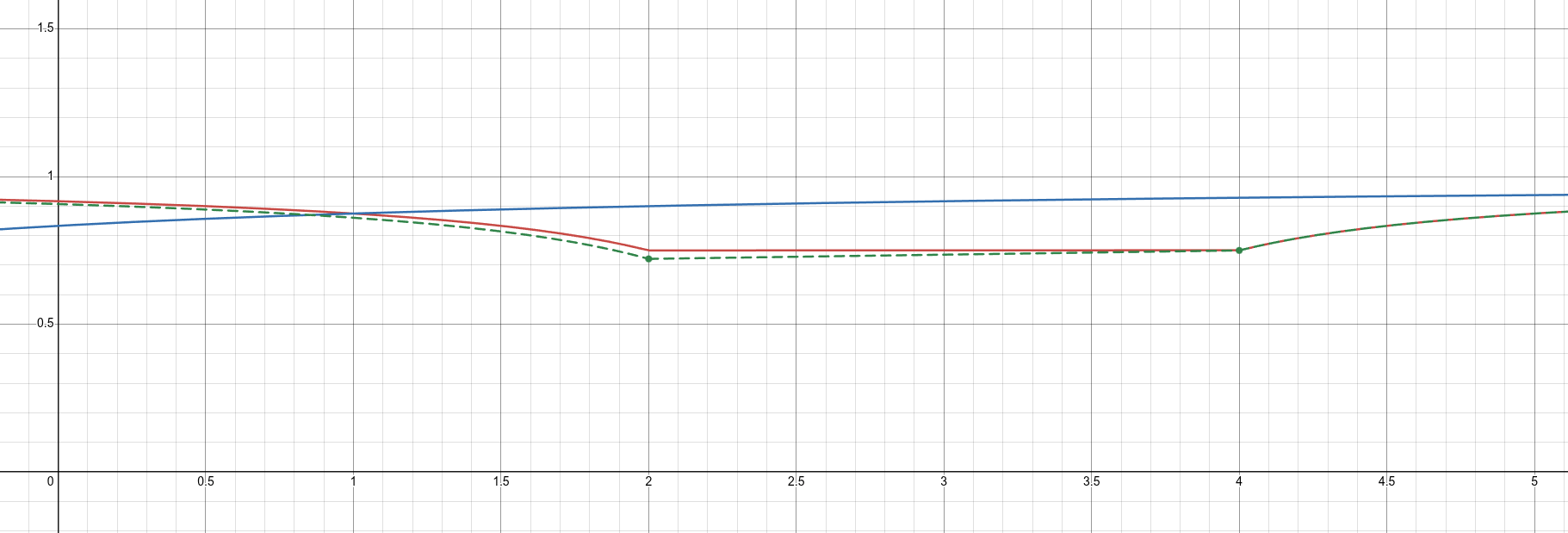
The energy gradient inside a particle ( a fixed amount unless altered by external gradients) is the particle’s own velocity (instantaneous acceleration), which determines its alpha factor. Below we have a stationary (red) particle of mass energy 0.25U₀ being accelerated to the left (dashed green) by an external gradient (blue).

Notice the blue curve is not affected by the particle at all. Locally, energy is not conserved. (However, our test particle creates a gradient which accelerates the particle causing the blue curve, so the total system balances.) Also notice how the acceleration is not influenced by the particle’s own mass/energy. Drop a feather and a hammer on the airless moon, and they both fall the same way.

Notice also that the particle is accelerated by the external gradient, but then retains this acceleration. This is why the Schwarzschild equation has two factors in the direction towards the attractive body: one for time (enormous, but decreases with speed), and one for space (minuscule, but increases with speed). Time flows much, much faster than distance does for relatively slow moving bodies, so the accumulated acceleration is much, much more of a factor than the instantaneous push of local acceleration. Light has double the expected curvature near the surface of the sun because it’s travelling distance r₀ in time t₀, so the internal and external accelerations are equal. Mercury orbits the sun a tiny bit faster than expected because it’s traveling so very quickly, and even more quickly nearest the sun. Also, the gradient across the diameter of a particle is always greater than at the central point. However, this difference is only really noticeable as you get close to the attractive body and the slope increases. Newton was fooled by the small angle approximation, which holds in everyday experience.

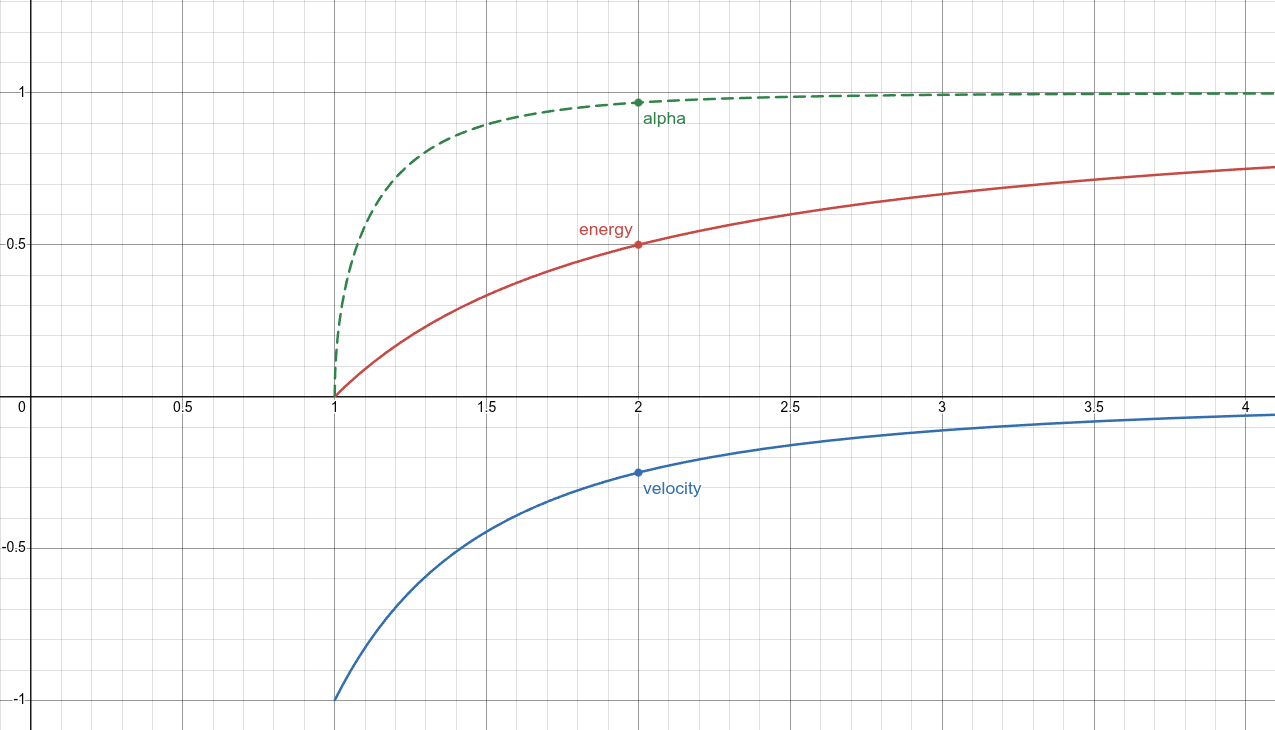
A highly observant reader might notice that these curves are somewhat different from the accepted values in General Relativity. (At the surface of the Earth and Sun, the values predicted differ at the ninth non-zero digit, a quantity several orders of magnitude smaller than current measurement errors.) Schwarzschild based his equation on the escape velocity of a particle approaching a body. At r = 1, this can be greater than the body’s own energy, which is nonsensical. However, the accelerated particle reaches the speed of light at distance r = 2 from a black hole mass, at which point the two particles impact each other (each having a radius of 1) and stop, there being no more energy to draw from. (You can’t have less than zero energy remaining in the field.) So, it’s not actually a contradiction. It’s merely incorrect to assume the energy of a body can be more than the actual energy of the body, and that the energy of a body can be more than the available energy. To give him credit, the concept of fields had yet to be invented, and energy still isn’t a well defined concept more than a century later.

Yes, every particle has the same radius r₀, with an inside and outside separated by a discontinuity. Why? Because Planck and Heisenberg said so. So does the geometry of 1/r, its derivative, and its integral. When combined with the finite total energy of U₀, this prevents infinities and singularities. A black hole is a thin region of maximal energy density surrounding a spheroid of zero potential energy.

You might have noticed the energy gradient (units: kg m²/s²) is being measured over a distance (m) in a time (s).  That gives momentum (kg m/s).  The mass (kg) is somewhat unimportant, as we convert it directly to energy (E = m c²).  It has no gradient, but it does take up an important amount of space, defining the size and shape of a particle!  And empty space has no mass, and thus no momentum.  So we can redefine energy (anyrgy?) for our purposes to ignore the kilograms and be simply /s².  

Empty space has energy gradients, and given the fixed speed of light and the fixed size of a particle, these gradients directly correlate to velocity.  However, we aren't truly adding velocities.  We are adding energy gradients.  They're not the same thing, although they appear to be at low energies.  The small angle approximation strikes again!

What are U₀, r₀, and t₀? I don’t know. A good guess is that they are based on the Planck units. If so, then U₀ ≈ 1.9561×10⁹ J, r₀ ≈ 1.616255(18)×10−35 m, and t₀ ≈ 5.391247(60)×10−44 s.


Friday, July 24, 2026

Door handedness and swing

Today’s nearly useless except when it’s absolutely necessary bit of knowledge:

Doors are normally described as they look and function from outside the room the door protects.

  • Visible hinges on the left = left handed (LH) door, as you open it with your left hand, handle points to the left, door swings to the left.

  • Visible hinges on the right = right handed (RH) door, as you open it with your right hand, handle points to the right, door swings to the right.

  • Door opens towards you = standard (no modifier). Hinges are on your side.

  • Door opens away from you = reverse(R). Hinges are on the other side of the door.

A door with the hinges facing you on the left side of the door, handle on the right, door swinging open towards you and to the left, is a left-handed (LH) door. The same door as viewed from the opposite side would be right-handed reverse (RHR).

Friday, July 17, 2026

Pumpkin Muffins

    I’ve been making pumpkin mini-muffins for decades. Everybody loves them. Nobody else ever seems to make them. I have no idea why. They’re great any time of year.

    This recipe uses a large (29-30 oz) can of pumpkin, and makes around 8 dozen mini-muffins. Cut recipe in half for a small can (14.5 oz). For a moister (also chewier and more pumpkiny) small batch, use a small can and a half. Yes, you can use cans of pumpkin pie filling to punch up the flavor level. Yes, you can add a half teaspoon of pumpkin pie spice. Play with the recipe. Make it your own.

Dry ingredients

4 cups all purpose flour

2 cups sugar (yes, I know sugar is generally consider to be “wet”)

1 tsp salt

2 tsp cinnamon

1/2 tsp nutmeg

1/2 tsp allspice

1/4 tsp clove

1 tsp baking soda

2 tsp baking powder

1 standard bag of chips (chocolate and/or peanut butter, or butterscotch)


Wet ingredients

1/4 cup milk (activates the baking soda) (I use vanilla almond ‘milk’.)

1 cup vegetable oil

1 large can pumpkin

1/2 tsp vanilla extract


Preheat oven to 375° F.

Mix dry. Mix wet. Mix the two together until thoroughly combined.

Spoon into generously oiled (cooking spray) mini-muffin tins.

Bake in the middle of the oven for 13-14 minutes.

Let cool for 10-15 minutes before removing from the tin onto a wire rack.

Store in a sealed container to retain moisture. (Pumpkin will stain some plastics.)


    This started out as a cookie recipe, back in the dim and hazy mists of time. You can make regular sized muffins by increasing the cooking time to 20-25 minutes.

Thursday, June 18, 2026

Enforced Errors

We in my neighborhood have been having massive problems with Amazon deliveries for the last month. Somebody finally stopped the Amazon delivery driver and asked him what changed. Why are so many (nearly all) packages being delivered to the wrong houses?

Back on May first, Amazon rolled out a new delivery app to their drivers. It shows where each package is to be delivered. The drivers are tracked, and their tablets record and report back via the app where each package went.

None of the delivery locations match up with the addresses on the packages. The driver knows this. The app doesn’t care. His boss will fire him if he delivers to the actual address instead of where the app tells him to.

This is what happens when the platform decay of technology interacts with the bureaucratic mindset. Everybody in the field knows the system is broken. Nobody in management cares. Amazon makes its money selling digital services these days. Actually delivering physical goods to customers is a side business relegated to the low performing managers.

Short Suspense

Once upon a time in the Army, our masters at V Corps in Germany would produce a memo every Tuesday, instructing all subordinate units what was expected and required of them the by Friday of following week. This memo would be duplicated, with appropriate numbers of copies placed in each directly subordinate unit’s mailbox cubby.

Our Brigade would pick up their mail on Mondays. (Notice that Monday, in this context, falls nearly a week after Tuesday.) They would then place our memo in our cubby in their mailroom. 40 miles away from us. I picked up our mail on Thursdays, and returned it to our Battalion in the afternoon.

Thursday is Sergeant’s Time, when every unit closed early, by decree of the Corps Commander.

Every Friday morning, the Platoons were told by the Companies what they had to get done before close of business. This normally consisted of a whole series of tasks that were generally expected to take 2 or maybe 3 days to accomplish.

Every week went the same. Every Friday was a madhouse of stress and pulling things from our posteriors to satisfy arbitrary requirements in insanely short timeframes.

We got good at it. We got really good at it.

One year, the Corps held an awards ceremony, inviting every major subunit (Battalion and above) commander. We eventually received our invitation to this gathering, along with our award, a week after it occurred. Go figure.

We received a unique, double-sided award plaque. On one side was an award for being the best unit in the Corps at making things up as we went along. On the other side was an award for being the worst unit in the entire Corps at planning anything in advance.

Tuesday, June 16, 2026

Random means "We have no idea."

What quantum mechanics leaves out of its "randomness is fundamental" picture is the state of the entire rest of the universe.  Equations for quantum states generally cover only one or a very low number of particles, interacting (or not) with a very limited environment.  The equations leave out the near-infinitude of states required by the generator to create the particles in question.  They completely ignore the near-infinitude of states required for the detector to function.  They ignore as irrelevant the near-infinitude of states of the surrounding apparatus.

Why?  Because the math is much, much too hard, and the measurements are essentially impossible to make to the precision required.  Therefore, "randomness is fundamental to the quantum mechanical process!"


Copenhagen Interpretation delenda est!

Sunday, June 14, 2026

Flag Day

You're a grand old flag
You're a high flying flag
And forever in peace may you wave

You're the emblem of
The land I love
The home of the free and the brave

Every heart beats true
'Neath the red, white and blue
Where there's never a boast or brag

Should auld acquaintance be forgot
Keep your eye on the grand old flag!

Saturday, June 13, 2026

Home security cameras

I'm going to say this up front - most home security camera systems are a waste of money.  Cameras don't truly deter crime any more - they provide a record of events after the fact.  And most cops don't care enough to actually use the video.  And lots of criminals wear masks these days, after the covidiocy made them acceptable in public.

That being said, if you really want a home video surveillance system, never, ever have indoor cameras.  Remember, in case of an actual event, the entire system will become evidence.  Do you really want video footage of everything you've been doing inside your own home made public record and examined in court?

Never get cameras that automatically record audio, either.  In many states, recording audio without the permission of all parties is a crime.

Never buy a camera system that sends ANYTHING out to the internet.  "The cloud" is just somebody else's computer.

All that being said, there are a few features you want to look for in a home security camera system.

One of the things you want to look for in a camera is an in-unit SD card.  They're not perfect, but local storage always works, even when the network goes down.  You'll want one that accepts UHS rated cards, if you can find one.

Another thing to look for, especially in places like Florida, is a wide dynamic range (WDR).  That means the camera can get decent pictures of a man standing in the shadows on a sunny day.  It also helps at night, when there are other light sources potentially blinding your camera to what's right in front of it.

Pan-Tilt-Zoom cameras are great as backups to the standard fixed view cameras.  Don't make them your primary cameras, because the PTZ features only work when you're actively using them.  Most people will use them once, then forget about them, and leave the camera zoomed in on where the squirrel (or woman in a bikini) was six months ago.

You want a wired system.  Trust me.  Yes, I understand you don't really want to cut more holes in the outside of your house.  No, you really don't want to run all those cables through your walls and across your attic.  But you do want your cameras to keep working for years, and that requires power.  The battery powered ones don't last any time at all, and you're not going to remember (or want) to get up on a ladder and change them out every month.  Did I say month?  I meant week.

Thursday, June 11, 2026

Larger than life

Some men's lives seem remarkably improbable.  These "larger than life" figures appear over and over throughout history.  These are the "great men" who change the world, for better or worse.  Leftist historians (the children of Marx) say that there are no great men, only the inevitable, scientific progression of history.

Pfaugh!

Please follow this link and read about Prentiss Ingraham, the man who fought in seven wars before the age of 30, then went on to befriend Wild Bill Cody and invent the Western novel genre.

Saturday, May 9, 2026

Post-Modern Education

The modern high school curriculum is misunderstood, even by the teachers. Geometry does not teach math. It teaches logical reasoning. By the same token, science classes don’t really teach science. They teach that the world is understandable, that effects follow from causes.

That being said…  I recommend a completely revamped form of primary education, focused on the 4 R's.  Reading, 'Riting, 'Rithmetic & Reloading.

I really do believe that primary school education should be limited to between the ages of 8 and 13. (Let the younger kids run around and play.  Family time is incredibly important.) You can teach the entire basic curriculum to children during those five years. It should include math (through basic algebra and statistics), English (reading, writing, literature), history & geography (taught together as stories of time and place), science (the basics plus logic), civics (including taxes, banking, and the political & legal processes), media literacy (how to tell when you’re being scammed), the arts (vocal & instrumental music, dance, drawing & painting), and life skills (home economics & child care, wood & metal shop, pottery, crocheting & sewing, laundry, cooking & baking). Daily gym classes for all (they need to move, and they’ll also learn the importance of teamwork and being a good sport.) Then you separate the kids into different groups by talent, interest, and sex for further education to age 16.

The top 20% of boys and 10% of girls (yes, I mean this seriously) go to college prep, formerly known as high school. A third to half should fail out of this process and move on to technical training.

The average middle get apprenticeships.

The bottom 20% get shovels, rakes, hoes, and brooms.

Group activities like sports, band, choir, dance, and theater continue to the age of 16 as well. You can’t do all of them, but you do have to participate in at least one of them. Each community shall create monthly activities to get the young men and women together in a chaperoned but fun environment. Bring back formal dancing (square, line, ballroom, folk, etc.) and roller skating! Add in junior versions of SCA/HEMA and ROTC, along with riflery & archery. Camping, fishing, hunting, gardening, farming, and animal husbandry should be offered as available and appropriate to the region, climate, and time of year. A reformed and restored version of Scouting would be appropriate and encouraged.

In my more perfect world, each school day would begin with recitations of the Pledge of Allegiance and the Lord’s Prayer.

Thursday, April 30, 2026

A simple randomizing mechanism

TTRPGs run the gamut from simulation (usually tactical) to “Once upon a time…” and everything in between. Most use dice, others cards, a few just pure imagination. Here is a simple mechanism for resolving chance in a more story-oriented game, using just one or more 6 sided dice. This will require much more active engagement by both the game master and the players. It also makes a simple but useful oracle for solo gaming.

  1. No, and

  2. No

  3. No, but

  4. Yes, but

  5. Yes

  6. Yes, and

Roll as many dice as appropriate, taking either the best or worst result as appropriate.

That’s it. It doesn’t have to be complicated.


Grammatical reminder: one die, many dice. It’s standard English, and has been for almost a thousand years. Don’t let fashionable ignorance ruin a perfectly good word.

Friday, April 24, 2026

How light bends, and other oddities

Einstein’s first prediction for general relativity was that light from distant stars passing closely by the sun during a total eclipse would bend twice as much as Newton’s laws of gravitation and motion called for. (No, this has nothing to do with the eclipse. That’s just the only time you can see things near the sun.) Many observations over the past century have proven him correct. By why does light do this?

Since the days of Newton, we have measured the attractive force of gravity quite precisely. The motion of the moon around the earth, the orbits of the planets about the sun, the falling of apples from trees, these are all data points rigorously collected, compiled, and compared. They all show the same force of gravity acting on massive objects. Well, they almost all do…

Mercury moves just a bit too quickly as it passes close by the sun. This advances its orbit just a tiny bit each revolution. There was no simple explanation for this. It was as if the carefully studied force of gravity changed when you got too close to the sun. Einstein invented general relativity in part to solve this conundrum.

Light from distant stars passing close by the sun during an eclipse was the earliest proof his theory was correct, or at least worked properly, which is generally the same thing. But why does light do this? The answer, as almost always, lies in the geometry. To the graph!

Here we have two test particles in the potential energy field, held motionless by the magic of wanting a simple example. The blue one on the left has a mass of 0.5 (the Planck mass = 1 in this model). The red one on the right has a mass of 0.25. They are close to each other, with one centered at -3, the other at +3. Each is, of course, of radius one, as are all particles regardless of mass. Once we release the less massive particle on the right, what happens to it?

The particle gains an internal energy gradient equal to the gradient of the ambient field inside its boundaries. This internal gradient grants it a velocity in the direction of the lower level of the field, towards the left. The internal gradient is now a permanent part of the particle’s energy profile, shown as dashed green. Well, permanent until the next moment in time, that is. Then the particle will once again gain an internal gradient equal to the gradient of the background field. This works almost like compound interest. As long as time keeps moving forward and the particle keeps moving, the internal gradient (the particle’s kinetic energy) will continue to change. This grants a steadily increasing velocity leftwards, toward the other particle. This is exactly as we expect and Newton so ably described.

But wait, there’s more! Notice that the particle taking energy from the gradient didn’t remove any energy from the gradient. It never does. That’s the trick Newton missed. The background gradient, upon which our humble test particle resides, remains a temporary and very localized modifier to the particle!

The gradient of the orange version of the particle is now doubled - but only while the particle is in this spot. Its internal energy gradient has not changed. That changes with time, which always advances at the speed of light. The modifier changes with position, which is to say distance. Slowly moving objects accelerate more slowly, since the time factor massively outweighs the distance factor.

  • Time for a particle moving along a gradient adds kinetic energy to the particle.

  • Distance for a particle moving along a gradient grants temporary velocity.

These simple rules explain why the perihelion of Mercury precesses too quickly around the sun, why light bends twice too much when passing close by the sun. The faster something moves, the more the temporary velocity boost of distance matters. This effect works with the particle’s velocity as a fraction of the speed of light. Light, moving exactly equally through both space and time, experiences equal effects from both.

What we have measured over the years with our relatively low speeds and feeble gravity around the earth is the compound interest of time. We ignored the simple fee of distance, because it disappeared as a minute rounding error. Remember, in the graphics above, a mass of one crates a black hole. Most particle masses are well below that, creating truly minute gradients. Especially seeing as most of the time, particles are incredibly far from each other at this scale.


An important note about this model: You’ll notice that both particles have radius one. This is true of all particles, regardless of mass/energy. Particles are not truly point-like. They have fixed sizes, even though this size is incredibly small. Particles are discontinuities in the field. They have an inside and an outside. You cannot get infinitely close to a particle without running into it. There are no infinities. There are no singularities.

The fixed radius of a particle has another effect. A slowly moving particle can gain energy from the same background multiple times because of the overlap. The more slowly it moves, the more quickly it will gain kinetic energy from the same background gradient. This, in effect, “flattens out” the force of gravity at great distances for slow speeds. This may help explain some of the effects attributed to dark matter.

Another effect of the field is that the particle’s total energy at that point in the field determines the rate at which time passes for it - the Lorentz alpha factor of time dilation. The lower you sink into the field, the more slowly time passes for you. It’s not just the gradient - it’s also the depth. A particle using up all the available energy would subjectively experience no time passing, or an alpha factor of zero.