One of the “oddities” of special relativity (SR) is that velocities don’t add in the way you would expect. Given a relativistic pirate ship traveling at 0.2c from your perspective (v), firing a cannonball straight forward at 0.3c from its perspective (u’), how fast do you see the cannonball moving (u)?
The SR formula for the addition of two velocities v (your perspective) and u’ (their perspective) is: u = (v + u’)/(1 + vu’).
Plugging in the numbers, we get u = 0.471698c.
How does this work with my particle and energy model of gravity and motion? Perfectly well, once you consider the geometry (well, trigonometry) of the situation.
Here, as a reminder, is the handy diagram of trig identities.
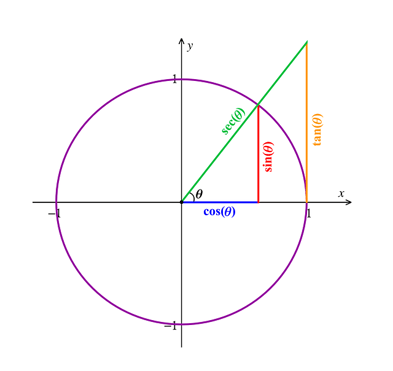
In special relativity, the speed of light is always constant and defined as one. That lets us use the trig circle to define terms in a different way. Since the hypoteneuse is c (1), velocity is sine and time dilation (Lorentz alpha) is cosine. (This is the fundamental principle of SR.) Since every particle is the exact same size, energy, velocity, and acceleration are all related, with energy being equivalent to the tangent (sin/cos) of the angle. Remember, only energies are real. Everything else is derived. But we can’t see energy, so we are usually forced to do things backwards.
So, how do we add energies in a geometric way using this knowledge? Carefully, with an eye towards the definitions. We know the velocities (sines). That gives us the time dilations (alphas). That gives us the energies. But we have to remember that the cannonball’s time dilation is measured from the ship’s time dilation. Just like you cannot directly add the velocities, you cannot directly add the energies.
The velocities (sin) add. The time dilations (cos) multiply. Energy (tan) is total velocity divided by total dilation. That’s the secret to relativistic energy addition.
Given the ship’s velocity from your perspective (v) and the cannonball’s velocity from the ship’s perspective (u’), we can define angles x and y such that x = arcsin(v) and y = arcsin(u’). We want to find the velocity of the cannonball from our perspective (u).
The definition of tangent: tan(a) = sin(a) / cos(a)
The relativistic addition of energies: tan(z) = [sin(x) + sin(y)] / [cos(x) * cos(y)]
u = sin(atan(z))
u = sin(atan( [v + u’] / [ cos(asin(v)) * cos(asin(u’)) ] ))
Plugging in our numbers for v = 0.2c and u’ = 0.3c, we get x = asin(0.2) and y = asin(0.3). That gives us tan(z) = 0.534951, so u = 0.471698c.
QED
And, as always, Copenhagen interpretation delenda est!

No comments:
Post a Comment
I reserve the right to remove egregiously profane or abusive comments, spam, and anything else that really annoys me. Feel free to agree or disagree, but let's keep this reasonably civil.