Einstein’s first prediction for general relativity was that light from distant stars passing closely by the sun during a total eclipse would bend twice as much as Newton’s laws of gravitation and motion called for. (No, this has nothing to do with the eclipse. That’s just the only time you can see things near the sun.) Many observations over the past century have proven him correct. By why does light do this?
Since the days of Newton, we have measured the attractive force of gravity quite precisely. The motion of the moon around the earth, the orbits of the planets about the sun, the falling of apples from trees, these are all data points rigorously collected, compiled, and compared. They all show the same force of gravity acting on massive objects. Well, they almost all do…
Mercury moves just a bit too quickly as it passes close by the sun. This advances its orbit just a tiny bit each revolution. There was no simple explanation for this. It was as if the carefully studied force of gravity changed when you got too close to the sun. Einstein invented general relativity in part to solve this conundrum.
Light from distant stars passing close by the sun during an eclipse was the earliest proof his theory was correct, or at least worked properly, which is generally the same thing. But why does light do this? The answer, as almost always, lies in the geometry. To the graph!
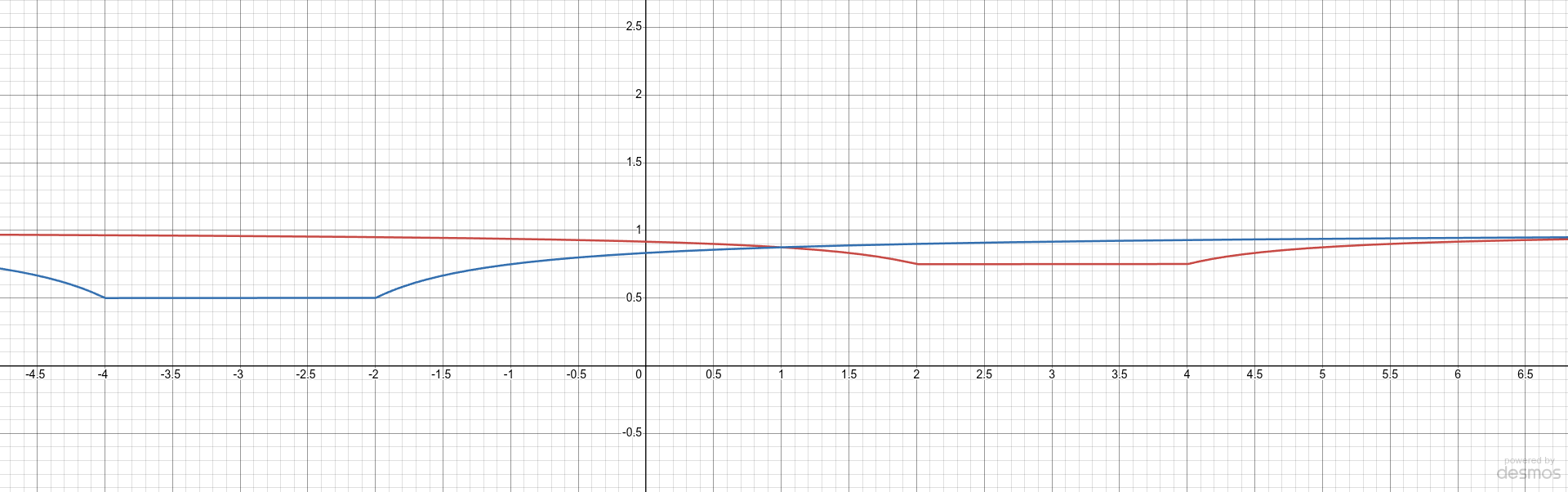
Here we have two test particles in the potential energy field, held motionless by the magic of wanting a simple example. The blue one on the left has a mass of 0.5 (the Planck mass = 1 in this model). The red one on the right has a mass of 0.25. They are close to each other, with one centered at -3, the other at +3. Each is, of course, of radius one, as are all particles regardless of mass. Once we release the less massive particle on the right, what happens to it?
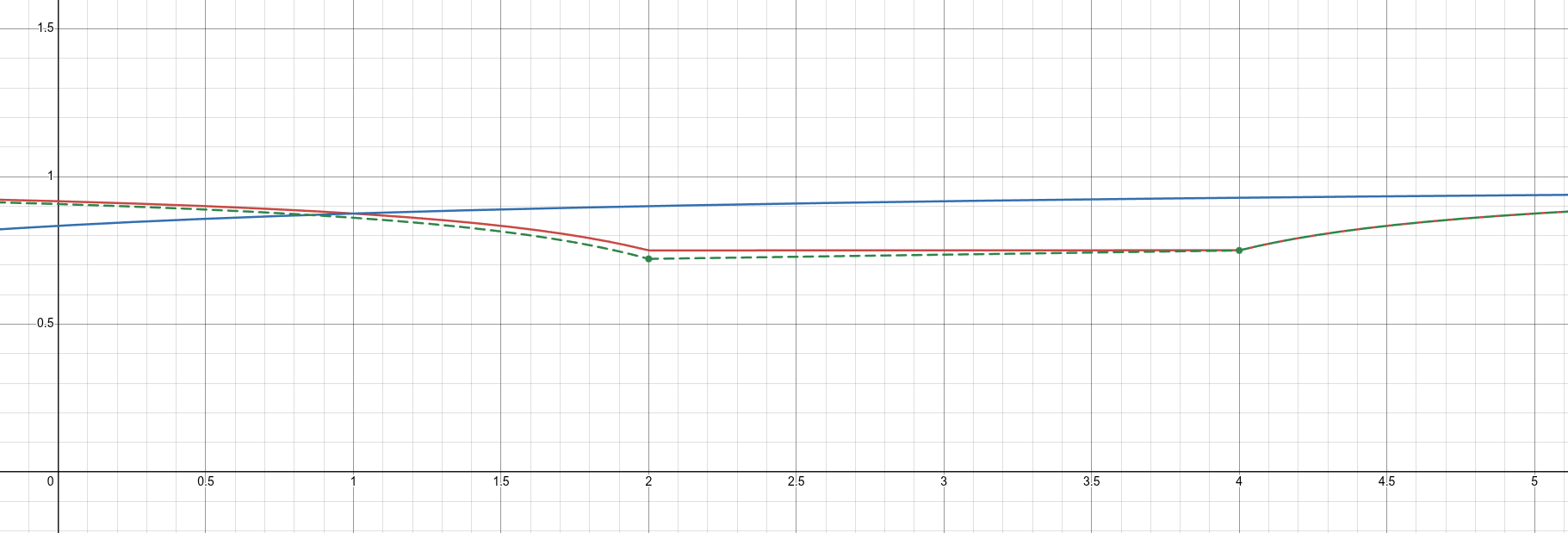
The particle gains an internal energy gradient equal to the gradient of the ambient field inside its boundaries. This internal gradient grants it a velocity in the direction of the lower level of the field, towards the left. The internal gradient is now a permanent part of the particle’s energy profile, shown as dashed green. Well, permanent until the next moment in time, that is. Then the particle will once again gain an internal gradient equal to the gradient of the background field. This works almost like compound interest. As long as time keeps moving forward and the particle keeps moving, the internal gradient (the particle’s kinetic energy) will continue to change. This grants a steadily increasing velocity leftwards, toward the other particle. This is exactly as we expect and Newton so ably described.
But wait, there’s more! Notice that the particle taking energy from the gradient didn’t remove any energy from the gradient. It never does. That’s the trick Newton missed. The background gradient, upon which our humble test particle resides, remains a temporary and very localized modifier to the particle!
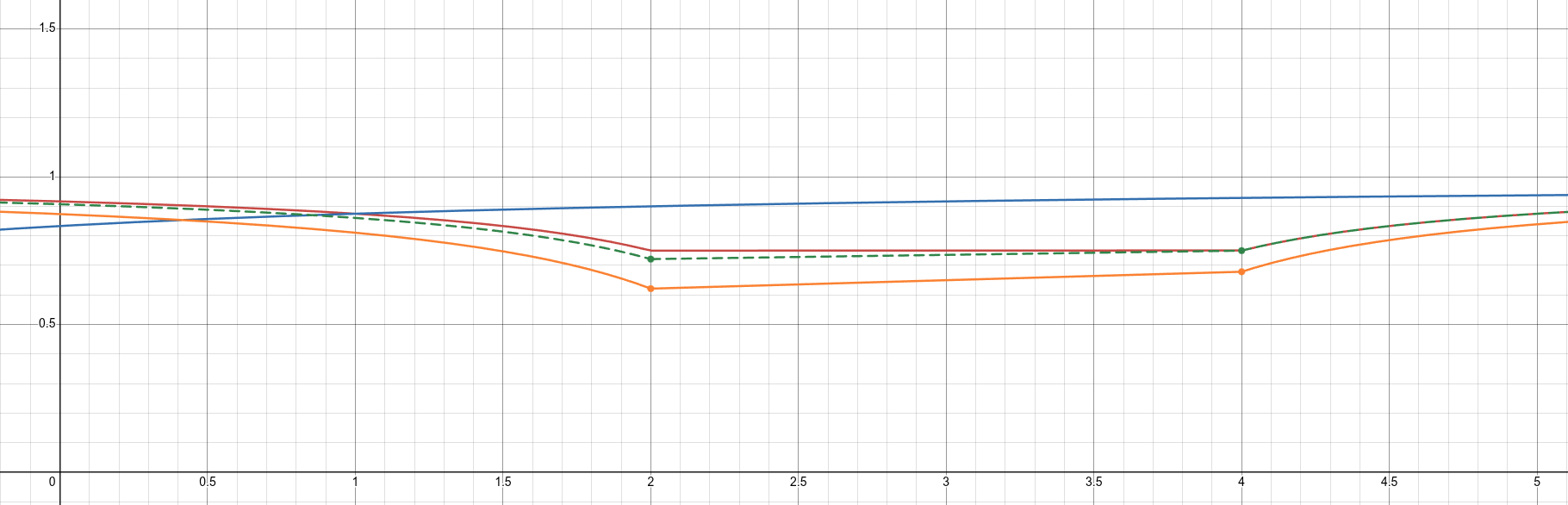
The gradient of the orange version of the particle is now doubled - but only while the particle is in this spot. Its internal energy gradient has not changed. That changes with time, which always advances at the speed of light. The modifier changes with position, which is to say distance. Slowly moving objects accelerate more slowly, since the time factor massively outweighs the distance factor.
Time for a particle moving along a gradient adds kinetic energy to the particle.
Distance for a particle moving along a gradient grants temporary velocity.
These simple rules explain why the perihelion of Mercury precesses too quickly around the sun, why light bends twice too much when passing close by the sun. The faster something moves, the more the temporary velocity boost of distance matters. This effect works with the particle’s velocity as a fraction of the speed of light. Light, moving exactly equally through both space and time, experiences equal effects from both.
What we have measured over the years with our relatively low speeds and feeble gravity around the earth is the compound interest of time. We ignored the simple fee of distance, because it disappeared as a minute rounding error. Remember, in the graphics above, a mass of one crates a black hole. Most particle masses are well below that, creating truly minute gradients. Especially seeing as most of the time, particles are incredibly far from each other at this scale.
An important note about this model: You’ll notice that both particles have radius one. This is true of all particles, regardless of mass/energy. Particles are not truly point-like. They have fixed sizes, even though this size is incredibly small. Particles are discontinuities in the field. They have an inside and an outside. You cannot get infinitely close to a particle without running into it. There are no infinities. There are no singularities.
The fixed radius of a particle has another effect. A slowly moving particle can gain energy from the same background multiple times because of the overlap. The more slowly it moves, the more quickly it will gain kinetic energy from the same background gradient. This, in effect, “flattens out” the force of gravity at great distances for slow speeds. This may help explain some of the effects attributed to dark matter.
Another effect of the field is that the particle’s total energy at that point in the field determines the rate at which time passes for it - the Lorentz alpha factor of time dilation. The lower you sink into the field, the more slowly time passes for you. It’s not just the gradient - it’s also the depth. A particle using up all the available energy would subjectively experience no time passing, or an alpha factor of zero.

No comments:
Post a Comment
I reserve the right to remove egregiously profane or abusive comments, spam, and anything else that really annoys me. Feel free to agree or disagree, but let's keep this reasonably civil.